📅 Multi-Calendar Lunar Tracking
🎯 The Problem
Lunar calendars are fundamental to billions of people worldwide for religious observances, agricultural planning, and cultural traditions. Yet most moon phase apps only show the Gregorian date and a basic phase icon, ignoring the rich calendar systems that give lunar cycles their practical and cultural significance.
⚙️ How It Works in MoonWise
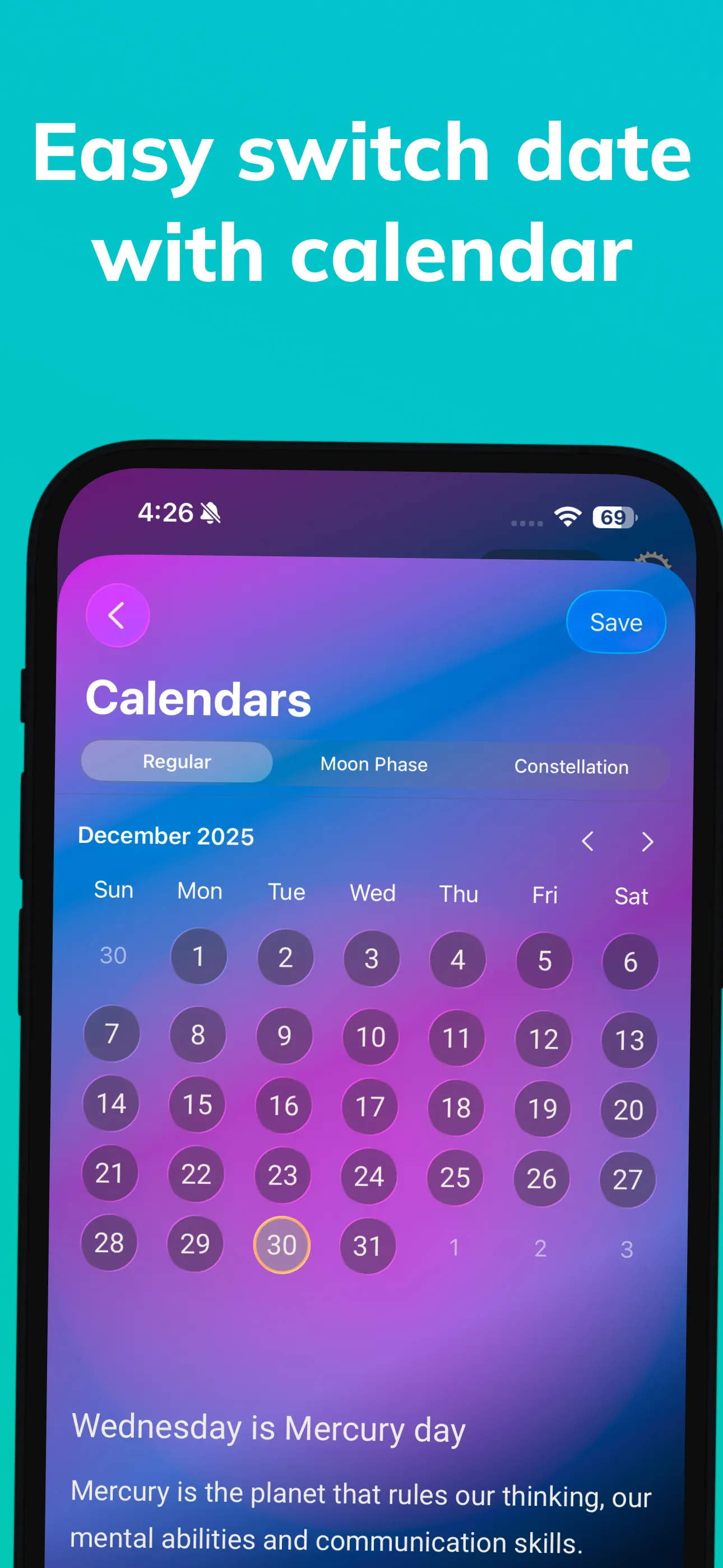
MoonWise supports 15 distinct calendar systems, each computed from authoritative astronomical and traditional sources. The app displays the current date in every enabled calendar alongside the precise lunar phase, illumination percentage, moonrise and moonset times, and the Moon's zodiac position. Each calendar system includes its own layer of culturally relevant information. The Islamic calendar shows Hijri dates with markers for significant months like Ramadan and Dhul Hijjah. The Hebrew calendar displays dates with Shabbat times and holiday indicators. The Chinese calendar shows the traditional lunar month and day with solar term markers. The Vedic panchang shows tithi, nakshatra, yoga, and karana. You can enable or disable any calendar from the settings screen and reorder them by priority. The home screen widget displays your primary calendar alongside the Gregorian date, so the information you need most is always one glance away.
Why Multiple Calendar Systems Matter
The Gregorian calendar is solar — its months have no relationship to the Moon’s actual cycle. But roughly 40 percent of the world’s population follows calendars that are either purely lunar or lunisolar, where months begin at the new moon or the first crescent sighting. For these communities, knowing the exact lunar phase is not a curiosity; it determines when holidays fall, when to plant crops, and when to observe fasts.
MoonWise was built with this global reality in mind. Rather than treating moon phases as an aesthetic overlay on Western dates, the app integrates 15 calendar systems as first-class features.
Supported Calendar Systems
MoonWise currently supports the following calendars:
- Gregorian — the international civil standard
- Islamic (Hijri) — purely lunar, 12 months of 29-30 days
- Hebrew — lunisolar with leap months
- Chinese — lunisolar with solar terms
- Vedic Panchang — traditional Hindu system with tithi and nakshatra
- Buddhist — lunisolar, used across Southeast Asia
- Persian (Solar Hijri) — solar calendar aligned with the vernal equinox
- Ethiopian — 13 months, offset from Gregorian
- Tibetan — lunisolar with unique intercalation
- Balinese Pawukon — 210-day cycle with multiple concurrent weeks
- Celtic — reconstructed lunisolar system
- Mayan Tzolkin — 260-day ritual cycle
- Biodynamic — agricultural calendar based on lunar and zodiac positions
- Farmers’ Almanac — traditional North American planting guide
- Japanese Rokuyo — six-day cycle used for auspicious timing
How Multi-Calendar Tracking Works in MoonWise
Unified Timeline View
The timeline screen displays dates across all your enabled calendars in a single scrollable view. Each day shows the Gregorian date at the top, followed by rows for each active calendar with its corresponding date and any special markers (holidays, fasts, planting windows, or auspicious days).
This unified approach eliminates the need to switch between separate apps or websites. Whether you are checking when Ramadan begins relative to a biodynamic planting window, or comparing the Hebrew date with the Chinese lunar month, everything appears on one screen.
Lunar Day Integration
Many calendar systems use the concept of a lunar day, but they define and count it differently. MoonWise handles these variations natively. The Vedic system counts tithis based on the angular distance between the Sun and Moon (each tithi spans 12 degrees). The Chinese system counts days from the new moon. The Islamic system traditionally begins each day at sunset.
The app displays the correct lunar day for each system without forcing a single standard. When you tap on a lunar day entry, a detail card explains how that system counts lunar days and what traditional significance the current day holds.
Moon Sign and Void of Course Across Cultures
Western astrology tracks which zodiac sign the Moon occupies and when it goes void of course. Vedic astrology tracks the Moon through 27 nakshatras. Chinese astrology associates the Moon with one of 28 lunar mansions. MoonWise computes all three systems from the same ephemeris data, so you can see how different traditions map the same astronomical reality.
This cross-cultural view is valuable for students of comparative astrology and for anyone who draws from more than one tradition. Understanding that a Western Moon sign and a Vedic nakshatra describe the same Moon position through different lenses deepens your grasp of both systems.
Practical Use Cases
Religious Observance
Users who observe Ramadan, Shabbat, Vesak, or Purnima can set MoonWise to display the relevant calendar prominently and receive notifications before significant dates. The app calculates these dates astronomically rather than relying on pre-published tables, which means it accounts for your geographic location when relevant (particularly for Islamic calendar sighting-based methods).
Agricultural and Biodynamic Planning
The biodynamic and Farmers’ Almanac calendars are designed for growers. MoonWise marks root days, leaf days, flower days, and fruit days based on the Moon’s zodiac position, following the system developed by Maria Thun. The Farmers’ Almanac layer adds traditional planting and harvesting guidance tied to lunar phases and frost date estimates.
Personal and Cultural Exploration
Even if you do not follow a specific lunar calendar, exploring how different cultures structure time around the Moon is educational. MoonWise includes brief descriptions of each calendar’s history and logic, turning the feature into a reference tool for anyone interested in how human civilizations have related to the lunar cycle.
Availability
All 15 calendars are available on the free tier with basic date display. MoonWise Premium ($9.99/mo or $79.99/yr) unlocks holiday notifications, calendar export to iOS Calendar, the home screen widget with multi-calendar support, and detailed cultural notes for each calendar system.
Try it in MoonWise
Track moon phases, void of course periods, lunar days, natal charts, and planetary retrogrades. Education first, then precision tools.
Free Download on App Store